
Continuing its heavy selling spree for the eighth consecutive month, foreign investors pulled out nearly Rs 40,000 crore from the Indian equity market in May on fears of an aggressive rate hike by US Federal Reserve that dented investor sentiments. With this, net outflow by foreign portfolio investors (FPIs) from equities reached at Rs 1.69 lakh crore so far in 2022, data with depositories showed. Going ahead, FPI flows will remain volatile in the emerging markets on account of rising geo-political risk, rising inflation, tightening of monetary policy by central banks, among others, Shrikant Chouhan, Head - Equity Research (Retail), Kotak Securities said.

The United States has joined India in condemning the terror strike in Jammu, with the two countries vowing to consolidate their efforts to eliminate terrorist safe havens and calling on Pakistan to bring to justice the perpetrators of the 2008 Mumbai attack.

Notwithstanding expectations of a pick-up in construction activity during a seasonally strong January-March quarter (fourth quarter) of 2022-23 (FY23), analysts are cautiously optimistic about the building material sector - encompassing paints, pipes, wood panels, tiles, metals, and cement - as volatile input costs, coupled with fears of a global slowdown, are making demand projections uncertain. Against this backdrop, analysts suggest investors stay selective and pick stocks of companies with stronger brand recall, expanding distribution network, diversified product profile, healthier balance sheet, and sustainable cash flow. "The government's various proposals under Budget 2023-24 (FY24) may lead to the building material segment growing between 8 per cent and 12 per cent for the next five years.

The ongoing oil price decline is mainly a result of oversupply in the global market

'Its people are either victims of corruption or witnesses to it.'

Supply chain constraints will keep plaguing automobile companies even though demand significantly improved resulting in a 13 per cent year-on-year (YoY) increase in sales in financial year 2021-22 (FY22). Executives at auto firms fear that the Russia-Ukraine war will further dent the sector's prospects of recovery as supply chains face more disruptions. "The visibility in the supply side is so hazy that it is difficult to give even one quarter projection. But all the parameters of demand like pending bookings and enquiries are increasing.

'India seems to be on a relatively better wicket compared to other emerging markets.'

Maruti's results and the investor response indicate that quite a few stocks in the auto sector could be on the verge of a big bounce, says Devangshu Datta.

Developing more sources of supplies to guard against disruptions may emerge as the next big trend. But that may not necessarily mean flow of more investments into India, unless investors are assured, besides important economic factors and impartiality of institutions, that social disharmony will not cause unexpected disruptions.

The Reserve Bank is working with the government to thrash out a payment settlement solution for Indo-Russian trade, which is hit by the economic sanctions imposed on Moscow after it invaded Ukraine, but asserted that any such solution will be 'sensitive' to the prevailing economic blockade, the central bank said. RBI Governor Shaktikanta Das was quick to add that it is a matter that the government has to deal with first, and as far as the central bank is concerned, obviously, we will not do anything which goes against the sanctions. RBI Deputy Governor T Rabi Sankar said since the Ukraine war has disrupted trade and payments, we are discussing with all stakeholders, and at the same time, we are sensitive to the economic sanctions.

'If it is your second car (electric vehicle), you typically keep it for travel within the city.' 'And the first car (internal combustion engine-run vehicles) can then be used to travel to some other cities.'

Indices across Indian equity markets have edged towards new record highs before undergoing a small correction in the past few sessions. The National Stock Exchange Nifty has gained 20 per cent in the past year; mid-caps (up 33 per cent), small-caps (up 31 per cent), and micro-caps (up 44 per cent) have done better. Several factors have precipitated this rally.
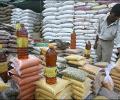
The agricultural supply system has to be able to respond to this increasing demand, which it is not able to do.

The minister emphasised that India will play its due role in advancing global food security and it will do so in a manner in which it upholds equity, displays compassion, and promotes social justice.

If they can sit together and hammer out 'Black Sea Initiative' deal for much needed food shipments, surely, they should be able to address the madness of the larger military conflict?
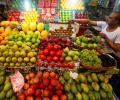
'RBI is already late in addressing inflation pressures.'

Petrol and diesel price hikes are likely to resume after state elections get over next week to bridge the Rs 9 a litre gap created by international oil prices soaring past $100 a barrel. International crude oil prices shot above $110 a barrel for the first time since mid-2014 on fears that oil and gas supplies from energy giant Russia could be disrupted, either by the conflict in Ukraine or retaliatory western sanctions. The basket of crude oil India buys rose above $102 per barrel on March 1, the highest since August 2014, according to information from the Petroleum Planning and Analysis Cell (PPAC) of the oil ministry.
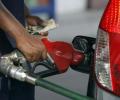
Petrol and diesel prices, which have been on a freeze for the past four months in view of assembly elections in states like Uttar Pradesh, need to be increased by over Rs 12 per litre by March 16 for fuel retailers to break even. International crude oil prices shot above $120 a barrel for the first time in nine years on Thursday before retreating a little to $111 on Friday, but the gulf between cost and retail rates has only widened. With international oil prices - on which domestic fuel retails are directly benchmarked - spiking in the last two months, state-owned fuel retailers "need a massive price hike of Rs 12.1 per litre on or before March 16, 2022, just to breakeven and a price hike of Rs 15.1 is required" after including margins for oil firms, ICICI Securities said in a report.
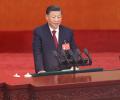
'No Cold War should be reignited and no Ukraine-style crisis should be repeated in Asia'

Restrictions imposed across the globe in 2020-21 due to coronavirus and the increased use of darknet resulted in two-to-three times jump in drug trafficking through couriers and postal services in India during this period, a latest NCB report has said.

A smartly executed reform-recap will be the best booster for the economy, says Ajay Chhibber.
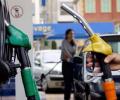
As the world's third-largest oil importer and consumer, India is running out of options as the relentless surge in international oil prices make it imperative to pass them on to consumers, officials said on Monday. India imports 85 per cent of its crude oil needs and about half of its natural gas requirement. While the imported crude oil is turned into fuels such as petrol and diesel, gas is used as CNG in automobiles and fuel in factories.
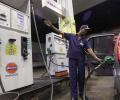
Petrol and diesel prices are likely to be hiked this week as oil companies prepare to pare losses accumulated from keeping rates steady for over four months in the run-up to assembly elections in five states, including UP, despite international oil prices jumping to a 13-year high of $140 per barrel. West Texas Intermediate crude futures, the US oil benchmark, rose to $130.50 per barrel on Sunday evening, its highest since July 2008, before retreating. The international benchmark, Brent crude, hit a high of $139.13 at one point overnight, also its highest since July 2008.

Apart from such advisory, IT biggies such as TCS, Infosys and HCL Tech among others have been pursuing 'remote working' model to overcome the situation.
International oil prices surged close to $100 a barrel on Tuesday after Russian President Vladimir Putin sent troops into Ukraine, but petrol and diesel prices in India continue to be on freeze and are expected to rise once assembly elections in states like Uttar Pradesh end. Amid fears of supplies being disrupted because of Russian aggression, the price of futures contract for Brent crude oil with April delivery on London's ICE rose by 4.18 per cent to $99.38 per barrel on Tuesday morning, before paring some gains to settle just above $98. The last time Brent exceeded $99 per barrel was in September 2014. Russia makes up for a third of Europe's natural gas and about 10 per cent of global oil production.
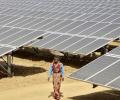
Arunabha Ghosh on why India will increasingly become an energy great power, but not an energy hegemon.

'A soft landing of the Indian economy would be a long-term positive for the equity markets.'
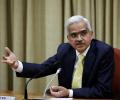
The Reserve Bank remains laser-focused to bring back retail inflation to 4 per cent over a period of time in a non-disruptive manner, Governor Shaktikanta Das stressed while voting for status quo in interest rates, as per minutes of the October policy meeting released on Friday. The central bank has been mandated by the government to ensure the Consumer Price Index (CPI) based inflation is at 4 per cent, with a band of 2 per cent on either side. The retail inflation, which was above 6 per cent during May and June, has started moving down and stood at 4.35 per cent in September.

Reliance Industries has put together an aggressive plan to build its drone business which includes expanding manufacturing capacity five-fold, participating in the new drone production linked incentive scheme, and experimenting with limited logistics payloads to deliver goods. The target is to become a key player in the expected $5 billion market in India by the end of the decade. The drone business is being carried out through a Bangalore-based start up, Asteria Aerospace, in which Reliance has taken a majority stake. Asteria is a subsidiary of Jio Platforms Ltd.
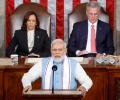
Here's the full text of Prime Minister Narendra Modi's address to a joint session of the United States Congress, delivered on Thursday.

'For the next two years, we expect the bulk of earnings growth contribution from sectors like financials and energy, where the outlook remains positive, while the sectors which are linked to domestic consumption and are currently witnessing strains on margins have low salience for Nifty earnings.'

Stating that an economic recession gripped global economy following the lockdowns due to COVID-19 pandemic, Fitch Ratings on Friday said the initial disruptions to regional manufacturing supply chains in China have now broadened to include local discretionary spending and exports.
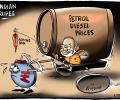
Oil sank to the lowest level in a month after shedding all of its gains from the US-Iran clash as traders waited to see whether any further hostilities will disrupt exports from the East Asia.

Although the pact would focus mainly on the Pacific and the South China Sea region, any action designed to deter China with or without New Delhi's active participation is a welcome move, notes Commodore Venugopal Menon (retd).
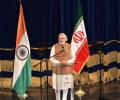
The Modi government caved in under American pressure without even token resistance. Two countries similarly placed as India with high dependence on Iranian oil -- China and Turkey -- have shown the grit to stand up to Washington, says Ambassador M K Bhadrakumar.

This crisis has arisen just as demand in India's auto sector started seeing some sort of revival after the nationwide lockdown in March/April.

The government will chart out a plan for the evacuation of seafarers stuck on international waters amid the Covid-19 pandemic, Union Minister Mansukh L Mandaviya has said. Thousands of Indian seafarers are currently stuck aboard cruise ships and cargo vessels in far off waters, and maritime bodies have been demanding from the government strategies for bringing them home fearing that delays might result in disruption in supply chain.

We should be relieved that we got the doses but we must also know where they came from and who was and who was not responsible for this achievement, notes Aakar Patel.

Illustrious international thinkers met at the Milken Institute Global Conference 2021 and many discussions addressed the impact of the COVID-19 pandemic on the world at large.

Companies from Unilever to Proctor & Gamble, Nestl, Coca-Cola and PepsiCo have all alluded to lockdown challenges in India and the globe as well as the impact it will have on April-June as well as full-year numbers.
